
Decode Classic VINs to Get Vehicle History Report and Build Sheet
Recommended Classic VIN Lookup Tools
10 Things to Know About the 1955 Chevy Bel Air
Dec 11, 2025
The Chevy Bel Air of 1955 is one of the most popular American automobiles. It is viewed by many as a new era for Chevrolet. It was new in appearance, had a strong new engine, and a style that continues to make heads turn today. The car enthusiasts, collectors, and families still enjoy talking about this special classic even after many years.
In a bid to understand why the 1955 Bel Air means everything to the world of cars, this guide will take you through the top 10 things you need to know. This blog will make you know why the 55 Bel Air is a high-rise American icon, both in its design and value today.
Key Takeaways
 The 1955 Chevy Bel Air introduced a new design, the first small-block V8, and contemporary features that made it a favorite at that time and today.
- Prices will be as low as project cars and as high as show cars that cost over $200,000, with convertibles and Nomads being the most valuable.
- The readily accessible components, robust design, and straightforward engineering make the 55 Bel Air one of the most preferred and most popular classics in restorations and restomods.
1955 Chevy Bel Air Specification
| Category | Specification |
|---|---|
Model Year | 1955 |
Manufacturer | Chevrolet |
Vehicle Type | Full-size car |
Body Styles | 2-door sedan, 4-door sedan, 2-door hardtop, 2-door convertible, 2-door wagon (Nomad), 4-door wagon |
Length | ~197.0 in |
Width | ~73.9 in |
Height | ~62.0 in (varies by body style) |
Wheelbase | 115.0 in |
Curb Weight | 3,100–3,300 lbs (varies by model) |
Engine Options | 3.9L (235 cu in) Inline-6, 4.3L (265 cu in) V8 |
Engine – Inline-6 Power | 123 hp |
Engine – V8 Power | 162–180 hp, depending on carb setup |
Fuel System | Single 2-barrel or optional 4-barrel carburetor (V8 models) |
Transmission Options | 3-speed manual, Overdrive manual, 2-speed Powerglide automati |
Drive Type | Rear-wheel drive |
Front Suspension | Independent front suspension with coil springs |
Rear Suspension | Live axle with leaf springs |
Brakes | Drum brakes (front and rear) |
Steering | Recirculating ball steering |
Top Speed | Around 90–100 mph (varies by engine) |
0–60 mph | About 12–15 seconds (varies by engine) |
Fuel Capacity | 16 gallons |
Interior Features | Bench seats, two-tone trim, AM radio (optional), heater (optional), carpeted floors on top trim |
Notable Firsts | First Chevy with a small-block V8 |
Original Price Range (1955) | $1,900–$2,200 depending on style |
Special Model | Bel Air Nomad (premium 2-door wagon) |
To know what originally came with a particular Chevy model, get the Chevy build sheet by VIN to know the original factory specifications, engine, capacity, colors, trim, production number, and options. It is the most effective way to prove that the classic car is original and worth the money today.
Nicknamed “The Hot One” with Serious Competition with Ford
The 1955 Chevy Bel Air was a huge revolution for Chevrolet. Before 1955, Chevy cars were not so sophisticated and fashionable. But in the year 1955, Chevy designed an entirely new model that was contemporary and thrilling.
The automobile was well-lined and chrome-bodied and brightly colored, and it was the center of attention in any street. Some say that the 1955 Bel Air was the vehicle that allowed Chevrolet to compete with Ford seriously.
It wasn’t just about the looks. The new technology and improved engineering and performance also accompanied the 1955 Bel Air. All this makes it a car that many car historians regard as one of the most important American cars ever to be made.
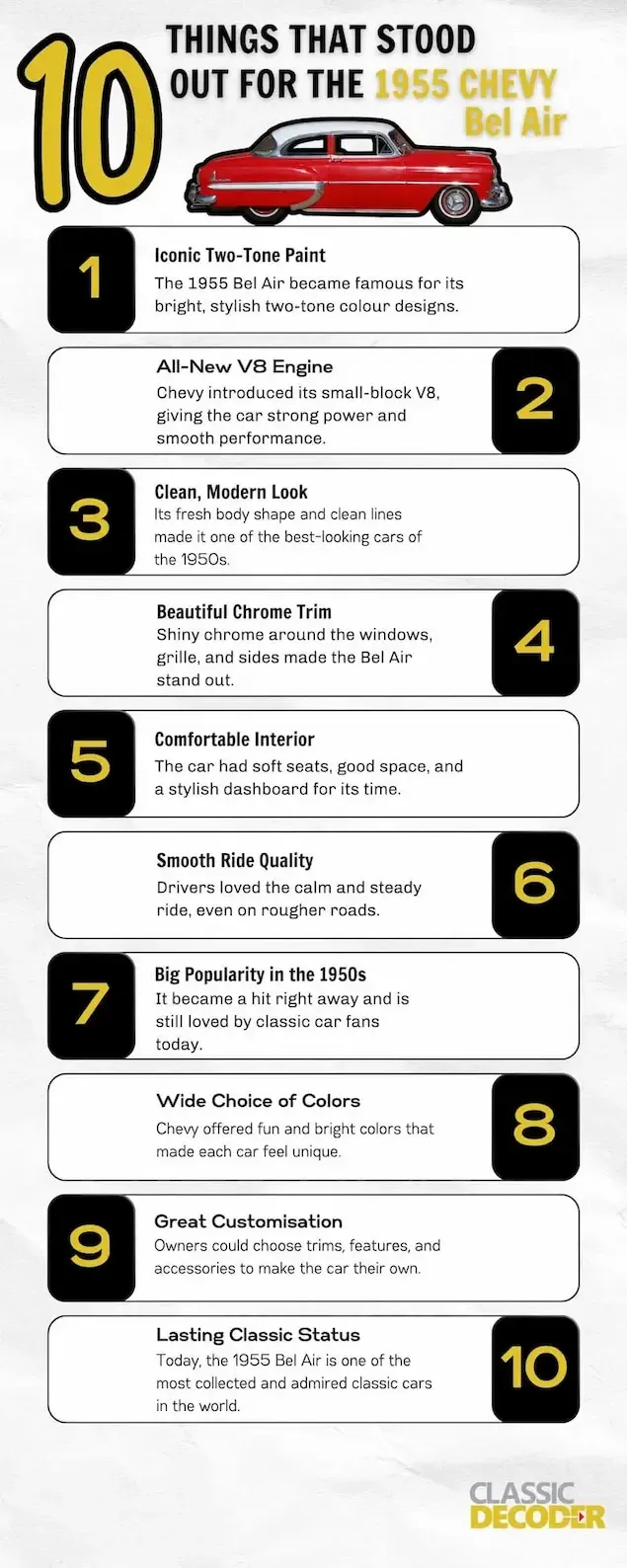
The New V8 Engine That Changed Everything
The fact that the 1955 Bel Air had a brand-new engine is one of the largest factors that made it famous. It was the first year Chevrolet had the small-block V8 engine, and it transformed the future of American cars.
This engine was lighter, faster, and more powerful compared to the older engines. It made the car playful to drive, and provided it with good speed at that time. The engine was also the foundation of most of the Chevy engines that followed after 1955.
According to many car enthusiasts, this engine ushered in an entirely new performance. The small-block V8 design is still familiar even in modern days, and people still discuss how it started with the Bel Air of 1955.
A Fresh New Look for the 1950s
The Bel Air of 1955 was a boldly designed car of the time. It was also more elegant and clean compared to older cars. The two-tone paint option was one of the things that attracted people’s attention as it gave the car two different colors, therefore making it appear more elegant and attractive.
It was also heavily trimmed with chrome. The side and front lines were polished chrome and this made the car look sharp and classy. The front grille was also changed to a wider, open-type, which was more powerful.
The bright colors and the shape of the car, the detail of the car, made it popular among families, teens, and collectors. To date, the 55 Bel Air is remembered as one of the best designs in the 1950s.
Breathtaking Interior Style and Comfort
The interior of the Bel Air of 1955 was as spectacular as the exterior. Chevy made the best efforts to make the interior comfortable, stylish and modern in those days.
The seats were fabricated in bright color, smooth fabrics and designs, which were similar to the exterior paint. The dashboard was also neater with well read gauges and 2 spoke steering wheel.
Even the doors, floor and roof were of the same color and all these made everything look like one well designed car. The 1955 Chevy Bel Air was more luxurious than the earlier Chevys and it provided a decent combination of comfort and style to the families. It was not a luxury vehicle, but it was a stylish sensation that most individuals loved.
Multiple Body Style Options For the ‘55 Chevy Bel Air
The 1955 Bel Air was available in a number of body styles, and this made it to become even more popular. The diverse range of styles is what made the Bel Air a bestselling car in the 1950s. Buyers were able to select the version that suited their needs or lifestyle.
Popular body styles buyers loved about the 1955 Chevy Bell Air include:
Two-Door Hardtop
There were no door frames around the windows in this version, which made the car look smooth and open. It remains one of the most popular styles even today.
Four-Door Sedan
This is perfect for a family, and it features door frames and increased passenger space.
Convertible
The top may be folded upside down, and it is a fun top on a sunny day. It has become one of the most valuable and rarest versions.
Station Wagon (Nomad and others)
One of the most fashionable wagons ever produced was the Nomad wagon. It was very special in its slanted back design and chrome details.
The Iconic “Tri-Five” Legacy
The Bel Air 1955 belongs to a collection known as the Tri-Five Chevys. These are the 1955, 1956, and 1957 Chevy. Car fans love all three years, yet the 1955 model is regarded as the most significant.
The Tri-Five vehicles were similar in shape and the popular small-block V8 engine. However, the model of 1955 began the entire series and brought the most significant changes in the design and engineering.
Due to this fact, a lot of individuals refer to the 1955 Bel Air as the beginning of one of the three-year stretches in the history of Chevy.
Affordable Performance for Everyone
Before '55, if you wanted a fast car, you needed deep pockets - that's just how it was. The Bel Air flipped that script by putting real power in reach of regular working folks. A V8 model ran around $2,200 brand new, which seemed almost too good to be true.
This whole idea of affordable speed basically planted the seeds for the muscle car explosion that came along ten years later. Chevy became a hero for proving you didn't need rich parents to own something quick and good-looking.
Chrome Detailing Done Right
The chrome on the '55 Bel Air hit that perfect balance - enough to look sharp without going overboard. That long body spear running down the side defined the whole profile. Bumpers, grille, window trim, and handles all got the chrome treatment, but it never looked cheap or excessive.
Some cars from that era drowned themselves in chrome like they were trying to be jewelry boxes on wheels. Chevy kept it classy, using brightwork to accent the design instead of hiding it. That's why a '55 still looks great today, while some other cars from back then just look ridiculous now.
Cultural Impact and Recognition
The 55 Bel Air had penetrated the American culture so much that it was no longer a mere car. Movies, television series, music videos - it appeared everywhere in the image of that entire optimism of the 1950s. Such an imposition of culture implies that these cars will never go out of fashion, no matter what happens in the collector market.
It is not about the metal and chrome anymore, it is what the car symbolizes. It could be sitting stock, it could be fully restored, or it could be radically customized, but a 55 Chevy still pulls up and attracts attention and gets people talking just as it did seventy years ago.
The 1955 Chevy Bel Air is a Favorite in Restorations and Restomods
The Bel Air of 1955 is among the most restored vehicles in the United States. It is the first choice of many people as a project car since it is easy to find parts and easy to upgrade.
The reason why restorers prefer the 1955 Bel Air is that the design is classic and the vehicle is powerful and easy to maintain.
Restomods that are classic cars rebuilt with modern engines, brakes, and technology are common with the 1955 Chevy Bel Air. A lot of classic car lovers love to have a car ride in a modern way, but retain the vintage appearance.
With the aftermarket industry being helpful, one can easily add new engines, air conditioning, disc brakes, or modern wiring to make the car safer and easier to drive.
READ ALSO: Classic Car Restoration Guide
How Much the 1955 Bel Air Is Worth Today?
The price of a Bel Chevy Air 1955 can fluctuate significantly. Its price is based on the condition, model, upgrades, and history.
The following are typical prices of a 1955 Chevy Bel Air:
- Project cars ($10,000-$20,000): Major work is required, or the car has been sitting for a long time.
- Good condition driver cars ($25,000-$45,000): These are in good running condition and are presentable, but they might not be in a complete state of restoration.
- Restored originals ($50 000-$80 000+): The cars are restored to appear new, and are highly clean.
- Restomods or high-end show cars ($100,000-$200,000+): These are of high-quality work, modern upgrades, or rare parts.
The most valued ones are the 1955 Chevy Bel Air convertible and Nomad wagon models. Popularity, demand, and originality also influence the price.
Common Issues Owners of Chevy Bel Air Should Watch For
Even though the 1955 Bel Air is a classic, it is still an old car, which means owners must watch for certain problems. Here are common issues:
- Rust: Rust is the most significant issue. It may be found in the floor, trunk, doors, rocker panels, and frame. It is a problem with many of the cars of the 1950s.
- Engine Wear: If the engine is old and not cared for, it can cause the engine oil to burn or loss of power.
- Frame Damage: Frames can be bent or damaged by being old or due to previous accidents.
- Electrical Issues: The old wiring may crack, short, or fail to work, resulting in lighting or starting problems.
- Suspension Wear: Springs, shocks, and bushings can wear out with many years of usage.
The majority of these issues are repairable, and most of the parts are readily available, which is one of the reasons why the Chevy Bel Air 1955 is still a popular car to restore.
1955 Chevy Bel Air Fun Facts You Should Know
The 1955 Chevy Bel Air has numerous amusing and unexpected facts. These facts demonstrate why the 1955 Bel Air is not just a car but a part of American history. Here are some popular ones:
- The car was featured in numerous films and TV programs, such as American Graffiti and Two-Lane Blacktop.
- The Bel Air of 1955 was the first Chevy with the small-block V8 engine that has become famous.
- In 1955, Chevy sold over 700,000 Bel Airs and this was a massive success.
- One of the most fashionable and exclusive wagons of all time was the Nomad wagon.
- The 55 Bel Air is among the most cloned, restored and rebuilt vehicles in America.
- Today it is among the most popular cars at the classic car shows and auctions.
Lookup any 1955 Chevy Bel Air History Before Buying One
Every 1955 Chevy Bel Air has a history that can affect its reliability and value. If you’re considering a 1955 Chevy Bel Air or any classic car model, you should get the classic vehicle history report before buying to show the ownership history, any title issues, odometer rollback, accidents, sales history, and more. This will help you avoid costly surprises and buy with confidence.
Frequently Asked Questions About the 1955 Chevy Bel Air
An old 1955 Chevy Bel Air can sell between $10,000 and $200,000 depending on whether it is a project car or a fully restored and rare model. The majority of well-maintained clean cars are sold at a price of between $40,000 and $60,000. It varies in price depending on its condition, history, upgrades and its originality. Restored or rare models tend to sell at a much higher price..
An average Chevy Bel Air 1955 is 195 to 195.5 inches in length, depending on body style. The hardtops are at 195.5 inches while the convertibles are a little shorter at approximately 195 inches.
The basic two-door sedan version of a Chevy Bel Air in 1955 was priced at approximately $2,025 and the wagon version, the Nomad, reached a high of $2,608. The price will be different depending on the body style and additional features that buyers added.

Content Writer
Peter Adewale is an experienced automotive writer with more than eight years of content writing experience. At Classic Decoder, he creates informative articles on classic cars, vehicle history, VIN research, restoration, and collector-focused automotive topics. Known for his research-driven and reader-focused approach, Peter is passionate about producing content that helps enthusiasts and buyers better understand vintage vehicles, verify important details, and make confident ownership decisions.