
Decode Classic VINs to Get Vehicle History Report and Build Sheet
Recommended Classic VIN Lookup Tools
Classic Car Restoration Tips: Everything You Need to Know
Dec 08, 2025
Reviving an old car is like reviving a piece of history. It is the dream of many car lovers to have a shiny, smooth-running vintage car that will draw attention on the road. However, to enjoy that moment, you’ll have to put in time, effort, and care.
This guide will take you through easy and useful classic car restoration tips that anyone, including beginners, can follow. You will get to know how to plan your project, how to manage your budget, where to get parts, and how to restore your classic car to its original glory.
Key Takeaways
 To restore a classic car is to repair it to the appearance and functionality it had when it was new. The project is less complicated and risky with planning, patience, and appropriate tools.
- Obtaining the classic car build sheet will assist you in ordering the right parts, retaining the car's original, and directing the restoration process. It guarantees your vintage car retains its original factory condition.
- After restoring your car, you need to maintain it to keep it running and looking good. Cleaning, checking fluids, storing it safely, and driving it gently are some of the ways to ensure that your investment is safe and that its value is not lost.
What Is Classic Car Restoration?
Classic car restoration is the process of restoring an old car to its original look and functionality. It is not merely repairing what is broken but rather putting it back into its original state when it came out of the factory.
Repairing, restoring, and modifying a car are different things. A repair is used to correct minor issues, such as a broken light or a worn-out brake pad. A restoration is more thorough, and it may require changing the engine, repainting the body, or reassembling the interior.
Modifying, however, refers to the introduction of newer components or alteration of the appearance or driving characteristics of the car.
How to Plan Your Classic Car Restoration
The most significant step to any classic car restoration is planning. It is easy to spend time and money without a plan. Obtaining the classic car build sheet can guide you on the right replacement parts to purchase.
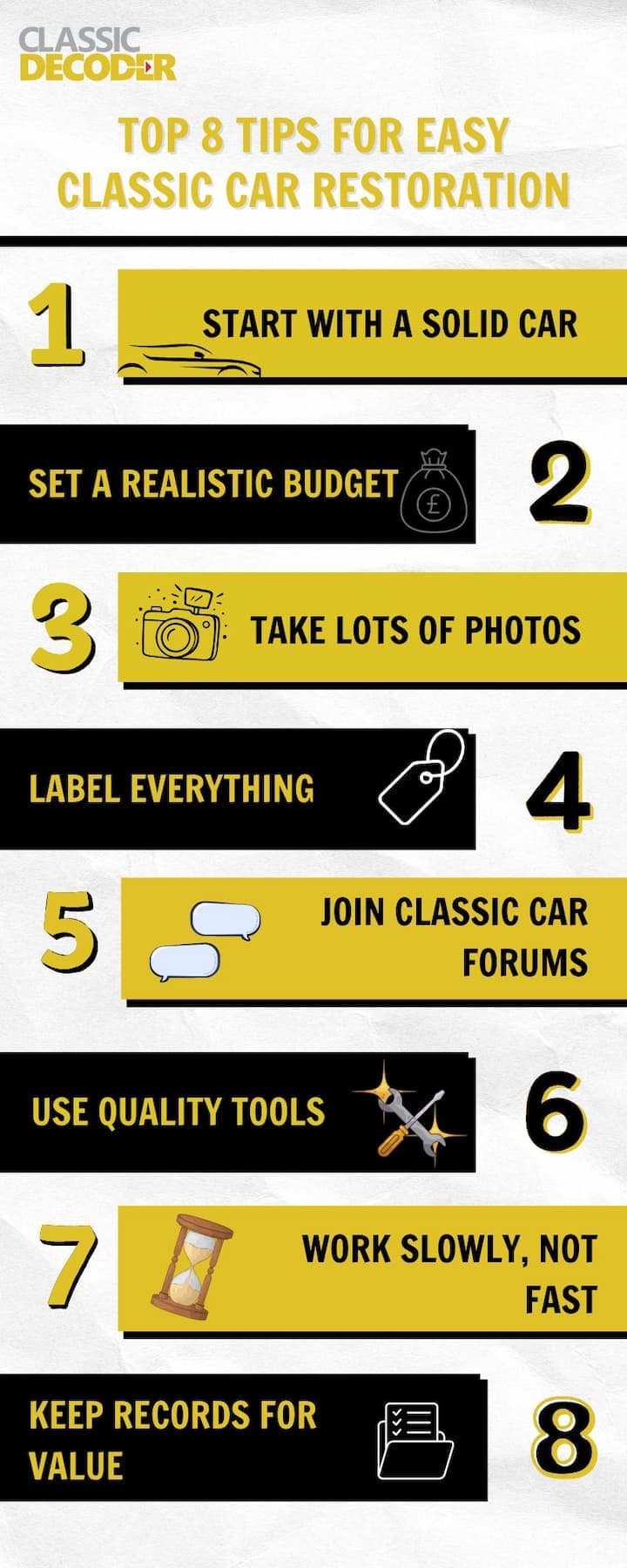
- Start by setting your goal: You need to ask yourself what type of car you want and how you want it to look when it is complete. Would you like a weekend car, a show car, or a complete rebuild? What you want to achieve will determine the amount of work and money you will require.
- Choose the right car: A beginner must begin with a model that has many parts available and is not too rare. Old and rare cars may be difficult and costly to restore.
- Do your research: Look for manuals, internet forums, and videos on how to restore a classic car step by step. This will help you have a better idea of what to expect.
- Carry out some inspections. Always inspect the car before purchasing it. Rust is costly to repair, and it is important to ensure that you are aware of what state the car is in.
Beginners can find classic car restoration very challenging, but it is all about learning as you go. Begin small, seek the assistance of professionals, be gradual, and enjoy it.
Read Also: Best Classic Cars You Can Restore Yourself for Cheap
Classic Car Restoration Cost: How to Budget for Your Project
The cost of restoring a classic car can be high; however, planning can keep you within your budget. The cost of the classic car restoration is based on numerous factors, such as:
- The car’s condition
- How rare it is
- The cost of parts
- Do you want to get a professional to do the job, or will you do it yourself?
Restoration of a car that is in good condition may cost between $3,500 and $12,000. Rebuilding, painting, bodywork, and replacing the engine can easily cost as much as $25,000 or more.
You could save some cash by doing some of the work yourself. It can be learned with time and patience to clean, sand, and even paint. You may also search for used or rebuilt parts rather than new parts.
Keep track of every expense. Write a list with tools, paint, replacement parts, and labour (in case you hire someone). There will always be unforeseen expenses, and therefore, keep a little more in your budget.
Lastly, keep in mind that it is not only about money when it comes to restoring a car, but also value addition. When properly done, your vintage car can be worth much more than the amount you invested in it.
How to Restore a Classic Car: Step-by-Step
A classic car restoration may seem like a huge process, but it is not hard when you follow the right steps. Here’s how to do it:
Step 1: Planning and Inspection
Begin with the inspection of all car parts. Examine the body, frame, engine, brakes and interior. Make notes of what should be fixed or replaced. Prepare a list of components to be purchased.
You also need to determine the type of restoration you are performing: full, partial, or cosmetic. To restore everything is to build up again. A cosmetic restoration puts more emphasis on appearance, such as paint and upholstery.
Step 2: Disassembly
Always take photographs of everything before dismantling anything. This will serve as a reminder of how to reassemble it in the future. Label every part, nut and bolt. Keep them in small boxes or bags.
It is better to be organized than sorry. Lots of unskilled restorers may lose elements or lose the means of fitting them. Be careful and take your time at this stage.
Step 3: Body and Frame Work
The largest issue in old cars is rust. Clean rusty places with sandpaper or a wire brush. In case the rust is extensive, you may have to cut and weld new metal.
Then fill it in with filler and sand it down. Before painting, check the frame, ensure that there are no cracks or weak points and repair it. Bodywork provides a solid and firm foundation for your car.
Step 4: Engine and Mechanical Repairs
Now go to the main part of your car, which is the engine. Determine whether it requires a complete restructure or minor repairs. Wash it, replace damaged components, retest it and put it back in.
Check the transmission, the suspension and the brakes as well. These systems play a significant role in safety. Change all rubber hoses and belts as they wear with time.
In case of replacing the traditional car parts, such as the engine and the transmission, the classic car build sheet can be accessed to give information regarding the original parts in order to order the right replacement parts.
Step 5: Interior Restoration
The interior of an old car contributes to its attractiveness. Repair or change seats, carpets and door panels. Wipe or paint the dashboard and fix any inoperative switches or gauges.
Attempt to get material that will resemble the original appearance of the car. This makes your car as real as it can be. Should this not be possible, then pick other close colors and designs that are compatible with the classic design.
Step 6: Painting and Finishing
One of the most thrilling aspects of an old car restoration is painting. Begin by rubbing off old paint and putting on a primer. Next, apply your preferred colour; preferably the one used by the factory.
Once painted, a clearcoat and a surface finish should be applied to make it shiny. You should take your time in this step; good paintwork makes your car look beautiful and makes it more valuable.
Step 7: Reassembly and Testing
When the paint has dried, have a good look at all the bits and pieces and put them back together. Follow your photos and labels. Begin with big sections and then smaller ones, such as badges and trim.
Once the car is assembled, you should test the systems of the car, like the lights, brakes, engine, and steering. Move slowly initially to determine whether everything is running fine. Adjust where necessary.
Step 8: Detailing and Presentation
This is the final touch. Wash the chrome, polish the windows and inspect all surfaces. Add a finishing touch, such as logos or hubcaps.
Whether you are about to take your car to the show or a cruise, detailing makes it come alive and look presentable. Make snapshots and have fun with your work.
You have just revived an oldie!
READ ALSO: A Guide to Car Restoration Shows
Tools and Materials Needed for Your Classic Car Restoration
You must have the right tools and materials before you start with your classic car restoration. These tools simplify your work, make it safer and more enjoyable. A clean and tidy workspace, such as a garage with ample light, will be a significant difference as well.
Let’s examine the most helpful tools and their functions:
Wrenches
One of the most significant tools of any car project is the wrenches. They assist in tightening or loosening nuts and bolts. Different parts of the car will require different sizes. Most jobs are well done with a set of combination wrenches (one open end and one ring end). Wrenching parts such as engines, doors, and bumpers is safe with the help of wrenches.
Socket Set
A socket set is a wrench that is quicker and simpler to operate. It has various socket sizes which fit to a handle known as a ratchet. It is possible to access narrow areas and loosen bolts faster with a socket set. It is ideal for dismantling engine parts and wheels.
Screwdrivers
Screwdrivers are either flathead or Phillips (cross-shaped). They are used to loosen or tighten screws in most components of a ca,r such as dashboards, interior parts, and small pieces of trim. A set of various sizes is a good idea.
Pliers
Pliers are used to hold, bend or cut wires and other tiny components. Types are numerous, such as needle-nose pliers in tight areas and cutting pliers for removing old wires. They come in handy when dealing with electrical components or tiny clips in the car.
Floor Jack
A floor jack is used to raise the car off the ground in order to work under it. It is particularly necessary when fixing brakes, changing tires or inspecting the suspension. Always have a floor jack that has a strong rating for the weight of your car.
Car Stands (Jack Stands)
After lifting your car using a floor jack, you will require car stands to ensure that it is held up. Do not just use the jack to support your car; it may slip. Car stands provide you with a stable support to work under the vehicle.
Work Light or Good Lighting
A bright room will make you see what you are doing. Install a work light or place lights in your garage. A lot of individuals switch to LED lights due to their brightness, safety, and non-heating nature. Lighting will assist you in identifying tiny cracks, leaks or rust that would otherwise be difficult to notice.
Sandpaper
Rough surfaces and old paint or rust are removed with sandpaper. It can be used manually or fitted into a sanding machine. It is among the key tools of the restoration of vintage cars, particularly prior to painting. Begin with coarse sandpaper to do rough work and use fine sandpaper to do smooth surfaces.
Grinder
A grinder is used to remove thick rust, old paint or damaged metal fast. It rotates at a very high speed and may be equipped with various wheels to perform various tasks. Body panels can be ready to be welded or painted using a grinder. Always wear safety glasses when using one.
Welder
A welder is the person who connects metal fragments with the help of heat. In restoring classic cars, one may be required to repair holes or areas that are rusted on the body. Welding skill requires practice, but a first-timer can become familiar with simple welding with time. Welding restores strength and durability to your car's body.
Spray Gun
Your car is painted with the help of a spray gun. It smoothly applies paint, unlike brushes, and makes your car have a shiny, fresh look as if it were made in the factory. You’ll also need it for a primer and clear coat. Test on scrap metal first, and then paint your car.
Primer
Primer is a kind of base paint, which is applied before the color itself. It assists the paint adhesion and increases its longevity. It also polishes the surface and prevents rusting of the metal. Primer is like the new skin on your car.
Safety Gear
Safety gear keeps you protected while working. You’ll need:
- Gloves to protect your hands from sharp edges and chemicals.
- Goggles or safety glasses to keep dust and sparks out of your eyes.
- Dust mask or respirator to protect your lungs when sanding or painting.
- Ear protection when using loud power tools. The restoration process is often messy and noisy, so you should think of safety first.
Cleaning Tools
Have rags, brushes and a vacuum cleaner on hand. Cleaning tools assist you in cleaning parts with dust, grease and dirt before reassembling. It is always easier to paint or repair a clean surface.
Tool Box or Organizer
There are a lot of tools that you will gather in the course of your project, and a toolbox or a drawer organizer will keep you tidy. Label little bits and bolts to prevent their loss. Being organized saves time and eliminates stress.
Air Compressor (Optional but Helpful)
Many tools, such as spray guns and air ratchets, are operated by an air compressor. It is also used to blow out dust or dry painted areas quickly. You do not require one to begin with, but it becomes easier as you gain experience.
Creating a Good Workspace
The quality of your tools depends on your workspace. Attempt to create a clean and dry space with sufficient space to move around the car. An outhouse or a big shed is best. Ensure that it is well-illuminated and has electric sockets to charge your tools.
Place rubber mats to cover the floor, and have a small table with parts and labels. The better your space is organized, the easier your restoration will be.
READ ALSO: Modernizing Classic Cars Guide
Common Challenges Faced During Vintage Car Restoration
The process of restoring an old car may be thrilling, yet it is not without difficult experiences. The following are some of the issues that may slow you down, cost more cash, and at times challenge your patience and abilities.
Spare Parts are not Always Readily Available.
One of the most challenging aspects of restoration is finding original parts for old cars. Most of them are no longer manufactured, and you may need to visit junkyards, online stores, or auctions. Certain parts may be extremely costly or take months to find.
Handling Structural Damage
Old cars are prone to rust and frame damage. Fixing these issues requires time, equipment, and expertise. You may have to cut out rusted parts, weld in new metal and inspect the car's structure to ensure that it is safe and strong once more.
High Restoration Costs
Classic car restoration may be more expensive than you think. Paint, tools, parts, and labour all add up. Some of them begin with a small budget and then realize that they require more funds to complete their dream project in the proper manner.
Legal and Documentation Issues
Old cars often come with missing or outdated papers. You might need to prove the car’s ownership, match VIN numbers, or get new registration documents. Without proper records, it can be hard to sell or drive your restored car legally.
How to Maintain Your Restored Classic Car
After restoring your classic car, it is important to maintain it. Regular cleaning, oil change, brake and fluid check are done to ensure the car is running smoothly and prevent damage. It should be kept in a safe, dry location at all times. Attempt to drive your car frequently but very mildly. This will keep the engine in good condition and will not allow the parts to get stuck.
Clean it frequently and wipe it to safeguard the paint. Keep it in a place where it cannot be damaged by the sun and rain. If you do not drive frequently, then start the car at least once a week to ensure that it is running well.
In addition, make sure that your car is clean on the inside. Leather or cloth seats may be damaged by dust and sunlight. Record every maintenance done; this will assist in safeguarding your investment as well as the history of your car.
RELATED: Classic Car Maintenance Tips
Why Restoring a Classic Car Is Worth It
It is worth restoring a classic car as it helps to revive the life of an old car and preserve its history. You get to preserve a piece of history, restore it to its beautiful state and even enhance its value in the future. It is a great way to reach into the past and create something that seems new.
It also makes you proud and happy. It is a great experience to see your efforts being rewarded. You will acquire new skills, know how cars operate and be glad to see your old beauty on the road once again.
Stay Classic With Classic Decoder Build Sheet
Classic car restoration is time-consuming, tedious and requires a lot of patience, but it is a wonderful experience when you see your old beauty shine again. This guide has provided all the vintage car restoration tips and information you need to start your restoration process.
It is high time to take the next step and obtain the Classic Decoder build sheet and find out the original specs, features, and factory details of the classic car before starting the restoration process.
We are the guys to call to get a copy of the original build sheets on old cars. Ride the classic timeless and have fun over the years.
Final Thoughts
The restoration of a classic car gives a new life to an old one, and it shines again in the eyes of buyers, enthusiasts, and collectors. Each of the parts you repair is a story. We have discussed some of the most common classic car restoration tips. You only need to be patient, organized and enjoy the adventure. You would see that your efforts are not a waste, as your old loveliness comes back to life once more.
Frequently Asked Questions on Classic Car Restoration
Choosing to fix or trade your old car depends on budget, condition, and plans. Fix it if repairs cost under half its value. Trade up if repairs are frequent, expensive, or you prefer modern safety and comfort.
Documentation and research are very important when restoring old cars. They help keep the car true to its history, prove it’s authentic, and increase both its value and the pride and joy of owning a genuine classic.
Repairing an old car is usually cheaper than buying a new one, even with big fixes. However, full classic car restorations can cost $40,000–$120,000. Your choice depends on the car’s condition, your goals, and your budget limits.

Content Writer
Peter Adewale is an experienced automotive writer with more than eight years of content writing experience. At Classic Decoder, he creates informative articles on classic cars, vehicle history, VIN research, restoration, and collector-focused automotive topics. Known for his research-driven and reader-focused approach, Peter is passionate about producing content that helps enthusiasts and buyers better understand vintage vehicles, verify important details, and make confident ownership decisions.