
Decode Classic VINs to Get Vehicle History Report and Build Sheet
Recommended Classic VIN Lookup Tools
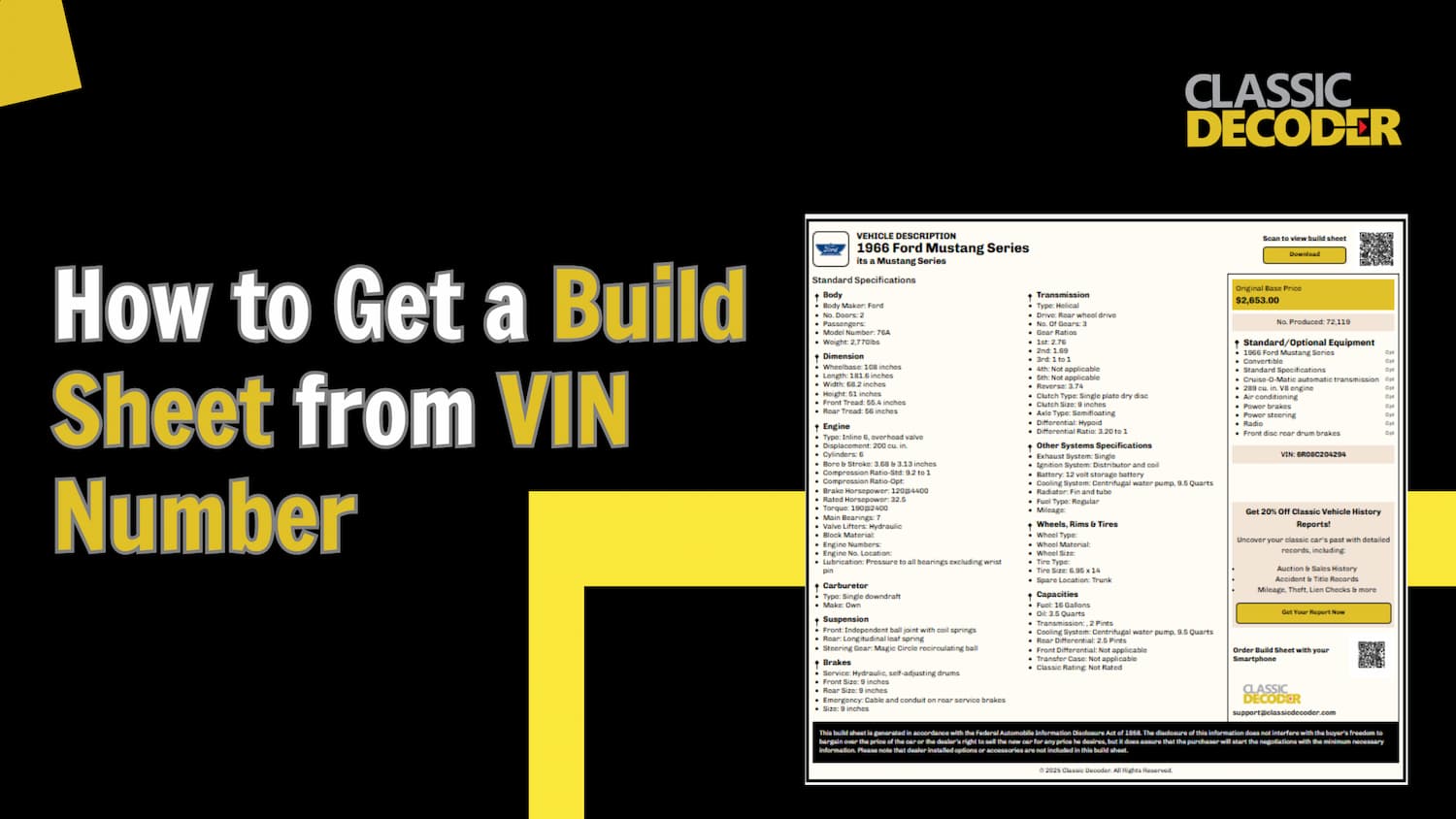
How to Get a Build Sheet from VIN Number
The best method of verifying a classic car’s full specs and factory-installed features is by checking the VIN number (Vehicle Identification Number). This special code contains important information on each car, like the make, year, engine, transmission, colors, options, and more.
When you have a classic car or are purchasing one, you can use a classic car build sheet tool to view the original factory information of the car by entering the classic car VIN, usually between 5 and 14 digits. This shows the way the car was when it originally came out of the factory.
This guide will define what a build sheet is, how to locate your classic VIN, and give instructions on how to get a build sheet from the VIN.
Key Takeaways
 A classic car build sheet shows what the car had when it was new, like engine, color, trim, original base price, options, and more. It helps prove the car is real.
- You can get a build sheet by VIN using the Classic Decoder tool. This helps you sell, buy, or restore a classic car the right way.
- Build sheets make your car worth more, help with insurance, and show it is real for car shows or collectors. It proves the car’s history.
What Is a Build Sheet?
A build sheet is a document that lists the original features a car had when it was first built. It represents the car’s birth certificate, telling you about the original details, factory-installed features, and equipment when the vehicle was made.
For classic cars, a build sheet often includes:
- The factory specifications, like engine and transmission type
- Standard/optional equipment
- The paint color and trim style
- The original base price when new
- The number of units produced for that model and year
These details and more help you see what your car looked like when it was brand new. It also helps you find out how rare a classic car is compared to others manufactured at the same time.
Where Do I Find the VIN Number?
The VIN is made up of 17 characters, i.e., letters and numbers that uniquely identify every car. However, classic cars manufactured before 1981 can have VIN numbers ranging from 5-14 digits.
Generally, you can find the VIN number by checking these spots:
- On the dashboard (look through the windshield on the driver’s side)
- On the driver’s door frame (inside the door near the latch)
- On the engine bay or firewall plate
- On important documents like titles or insurance papers
For classic cars built before 1981 and with VIN numbers shorter than 17 digits, you will need a special classic build sheet by VIN tool like Classic Decoder to accurately get the full build information.
Read Also: How to Check VIN Number on Classic Car
How Can I Get a Build Sheet from VIN: Step-by-Step Guide
You can easily get build sheets for any classic cars using our classic build sheet by VIN tool. Here are the simple steps to follow.
Step 1: Locate Your VIN Number
Find your VIN using one of the spots listed above. Check that it’s clean and easy to read. Write it down exactly as it appears because a small mistake can give the wrong result. Older classic cars may have fewer than 17-digit VIN numbers, depending on the manufacturer.
Step 2: Visit the Classic Decoder Website
Go to the Classic Decoder website. On the build sheet page, you’ll see a form that lets you enter the classic VIN number. The tool can decode the VIN number of any classic car made since 1905.
Type the VIN carefully into the search box. Make sure every letter and number is correct. Then click “Decode Classic VIN.”
Step 3: Retrieve the Classic Car Build Sheet
Within a short time, you’ll get a detailed classic build sheet that shows your car’s original features, including:
- Model and year
- Engine and transmission information
- Options and packages
- Paint and trim details
- Base price when new
- Total number produced
Once the build sheet is generated, you can view and download it as a PDF file or print a copy for your records. It’s a great document to keep with your car’s paperwork, especially if you plan to sell or restore it.
The Benefits of Getting a Classic Car Build Sheet
A build sheet is more than just a list of car details; it is proof of your car’s story before it ever had its first owner. It tells you what the car looked like when it was brand new and what made it special. Here’s why every classic car owner or buyer should get one:
Verify Originality
A build sheet will allow you to know whether your car still has the same engine, color, and configuration it had when it was made at the factory. With time, a number of cars are repainted or reassembled using other components.
The build sheet will help you identify the parts that are original and those that have been modified by comparing your car to the build sheet. This assists the collectors and buyers in being aware of the actual value and authenticity of the car.
Help with Restoration
Everything counts when it comes to restoring a classic car. A build sheet provides the right information regarding paint colors used by the factory, the type of trim, and engine configurations. You can take it as a guide to restore your car to its initial appearance and performance.
Redoing the interior, repainting, or replacing parts? The build sheet assists in ensuring that every detail is similar to the way the car was assembled decades before.
Discover Rarity
The build sheet will inform you of the number of cars of your model that were manufactured during that model year. There are classic cars that are among the few that were ever manufactured, making them unique and thus more valuable.
It is important to know the production numbers of your car to know its position in history. It is also possible to use this information to compare your car to others and determine whether you have a rare edition or special trim level.
Boost Resale Value
A build sheet can add significant value to your car when you are selling it. Customers believe in cars that have confirmed documentation. A build sheet will show that your car is genuine and was maintained in good condition.
It demonstrates that you have done your research and ensured that it is original, and this creates trust, and in most cases, you are likely to sell it at a higher price.
For Insurance and Car Shows
There are numerous insurance firms and classic car exhibitions that demand evidence that a car is authentic. A build sheet is such evidence. It depicts the original appearance of the car when it was produced and makes sure that it has not been greatly changed.
This facilitates easier access to adequate insurance cover and access to classic car shows or contests. It is a basic piece of paper that gives your car credibility and makes it stand out.
Preserve Classic Car History
A build sheet is a reminder of your car's history to future generations. It links you to the date and location of manufacture of the car. You can observe which details were in demand at the time and how the car designs have evolved over the years.
Having a copy of your classic build sheet is akin to having a piece of automotive history, and it safeguards the legacy of your car, as well as allowing others to fully understand its true origin and history.
The Information You’ll Find in a Classic Build Sheet
A build sheet gives you a clear picture of how your car was made when it left the factory. It lists all the important details about your car’s design, setup, and original parts.
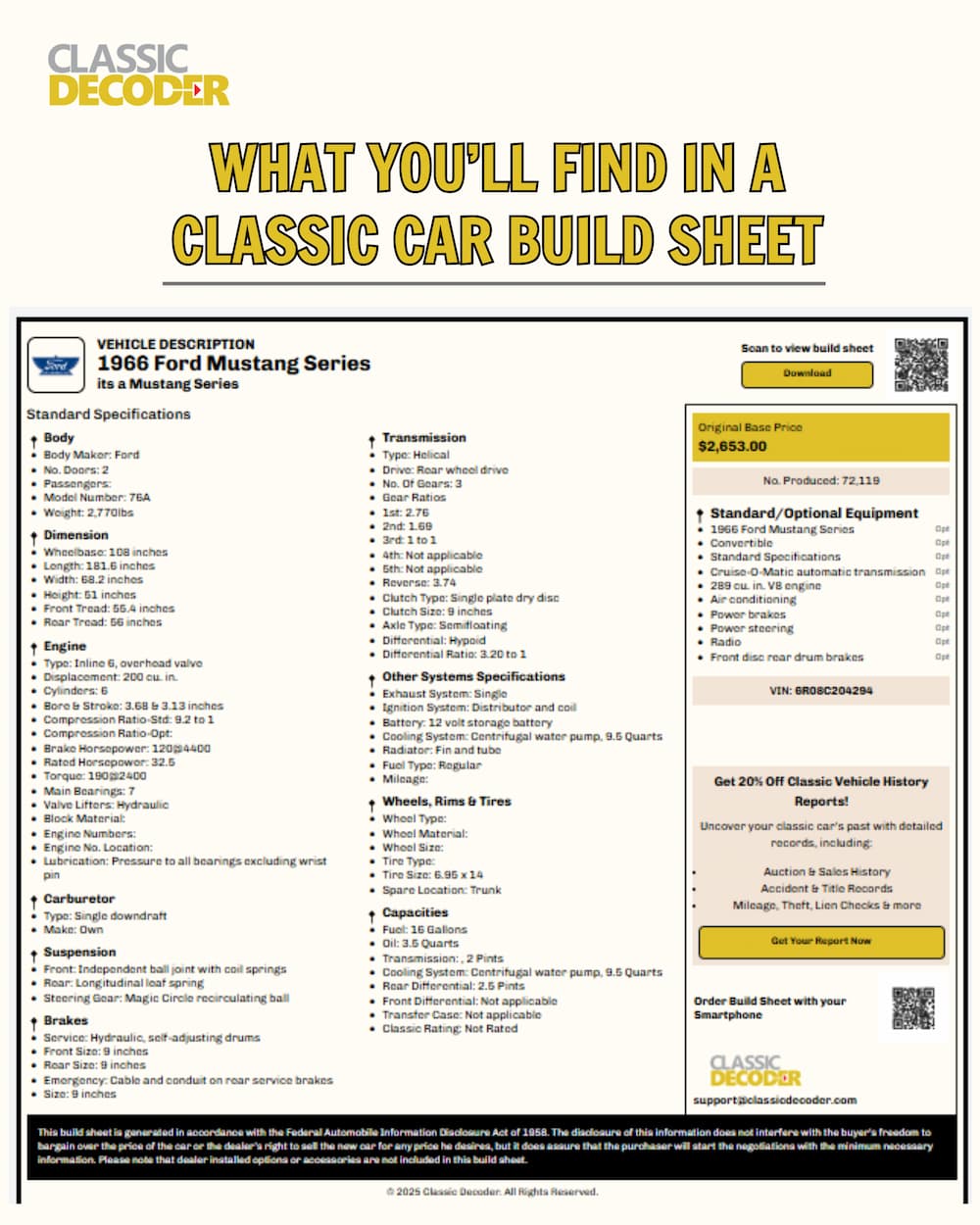
Here’s what’s usually included:
- Vehicle specifications: Shows the car’s basic details, including model name, year, and main factory features.
- Engine: Tells the engine type, size, and power your car had when first built.
- Transmission: Explains the original gearbox or powertrain setup used by the factory.
- Exterior paint and trim: Shows the car’s factory paint colour and the style or trim it came with.
- Original base price: Tells you what your car cost when it was first sold brand new.
- Production numbers: Shows how many cars like yours were made during that specific model year.
- Standard and optional equipment: Lists what came as standard and what could be added as factory upgrades.
- System specifications: Includes key parts like exhaust, ignition, battery, radiator, and cooling system details.
- Body and dimensions: Shows the car’s length, width, height, and other important body measurements.
- Capacities: Lists fuel tank size, oil amount, and other fluid capacity information.
- Carburetor: Gives the carburetor type and setup that controls fuel and air flow.
- Suspension: Shows the suspension type used to give smooth handling and ride comfort.
- Wheels, rims, and tires: Details the original wheel size, rim type, and tire dimensions from the factory.
- Brakes: Explains the braking system, including whether the car uses drum or disc brakes.
- Model number: Lists the factory-assigned model or trim number used to identify your vehicle.
If you’re looking for all this information about a classic car, you can get the classic build sheet by VIN. It’s the easiest way to learn about how unique and special a classic car is for potential buyers and collectors.
How a Build Sheet Helps Classic Car Owners
A build sheet is an invaluable resource to any individual who owns, restores, or purchases classic cars. This is how it assists the various owners:
For Buyers
- A build sheet will help buyers not to overpay for cars that do not appear to be. It assists in confirming whether the engine, paint, and options are the original factory specifications.
- This document will enable buyers to shun cars that have been rebuilt using incorrect parts or colors.
- It creates confidence by revealing the true identity of the car they are buying.
- To a layman who has never purchased a classic car, a build sheet makes the purchase less risky and guarantees that you are getting a true, honest car that is worth the money.
For Sellers
- A build sheet provides evidence and credibility when selling a classic car. It informs the potential buyers that the information about the car is accurate. This type of record provides a definite competitive edge in the market.
- It also helps in justifying a higher asking price, as verified cars tend to fetch higher prices.
- The build sheet also allows the sellers to display the unique or rare features of the car, thus attractive to collectors and enthusiasts.
For Restorers
- A build sheet gives the original paint color of the car, the interior trim, the type of engine, and many other details that will make the car exactly as it was when it came out of the factory.
- With the build sheet, it becomes easy to confidently know about the right partsfor restoration.
- It can also help restorers to find rare parts or accessories that fit the year and model of the car, so that all the details appear to be authentic and historically accurate.
For Collectors
- The build sheet establishes the authenticity of a car by demonstrating that the car parts, color, and configuration are all original and have not been refurbished or altered.
- This sheet draws a line between the real classics and the fake, or the cars that are highly modified.
- A confirmed build sheet adds to the collectible value of the car and helps collectors display their cars proudly in exhibitions, auctions, or even in their own collections.
- It also gives it a historical pride, which links the collector to the production history of the car.
For Insurance and Valuation
- Build sheets are used by the insurance companies and appraisers to check the originality and specification of your car.
- The document assists in making sure that your vintage car is appraised reasonably and insured at its actual value.
- A build sheet provides them with evidence of authenticity, which helps you obtain the correct policy
- It can also be used in the process of making a repair or restoration claim by ensuring that the right parts and features are restored.
For Car Shows and Exhibitions
- Auto shows and exhibitions usually demand documentation of the fact that a car is factory-correct. A build sheet gives this evidence and proves that your car has original colors, equipment, and setup.
- It increases the credibility of your entry to the judges and car lovers.
- The possession of such a document may also enhance your chances of receiving awards, as it shows that you pay attention to authenticity and preservation.
- Most owners of classic cars have their build sheets on display next to their cars as a part of their car story and legacy.
Read Also: Chrysler Build Sheet Lookup Guide
A Classic Build Sheet Is Not a Vehicle History Report
A build sheet and a vehicle history report are two very different things. A build sheet shows how the car was first made, including its color, engine, and original parts straight from the factory. It’s like the car’s birth record, and it helps prove a classic car's originality.
A vehicle history report, on the other hand, tells what happened after the car was built. It includes past owners, lien records, accident records, mileage or title information, sales records, and more. It’s usually helpful when buying a classic car, ensuring your classic car investment is secured, and you don’t end up
Conclusion on How to Get a Build Sheet from VIN Number
A build sheet represents your classic car’s story from the day it was born and before it had its first buyer. By knowing how to get a build sheet from VIN number, you can access the original specs and factory-installed features and see exactly how your car was made.
Since classic cars VIN numbers before 1981 are not standardized, finding accurate build sheet information is made possible with the classic build sheet tool. It helps find classic build info effortlessly. This is very useful in making informed decisions when buying, restoring, or collecting classic cars.
How to Get Build Sheet from VIN FAQ
Yes. You can access the build sheet for any car using the VIN number. For classic cars with 5-14 digits, use our classic build sheet by VIN tool. If the vehicle has 17 digits, you can use other build sheet providers like Detailed Vehicle History, Instant VIN Reports, and VehiclesReports.
You can get your build sheet almost instantly through the Classic Decoder website. Once you enter the VIN and launch, the build sheet gets ready in a few seconds, available to be viewed and downloaded
Yes, you can. A VIN number can be decoded with a car build sheet to show the car’s original build sheet, showing details like the specs, options, packages, paint color, engine type, and more.
Yes, simply use our free VIN decoder to access accurate and detailed car specifications by VIN number. Verify the year, make, model, trim, transmission, and more.
No, Carfax does not give a real build sheet in its reports. The Carfax report mainly shows a car’s history, not how it was built. It may use some VIN data from build sheets, but its reports focus on accidents, service records, ownership, and more.
In the real sense of it, a build sheet and a window sticker are two different documents. The build sheet lists every factory detail, code, and option used to build the car.
The window sticker, however, shows the car’s MSRP, fuel economy, options and packages, colors, safety ratings, and main features. The build sheet simply acts like the car’s birth certificate.

Senior Content Writer
Joses Peter is a professional automotive writer at Classic Decoder with a strong background in long-form content and technical writing. With a portfolio of 100+ blog posts and two published papers, she covers classic cars, vehicle history, VIN lookup, restoration topics, and automotive technology in a way that is easy for readers to understand. Her passion for automobiles and research helps her turn complex subjects into useful, reader-friendly content for collectors, buyers, & enthusiasts