
Decode Classic VINs to Get Vehicle History Report and Build Sheet
Popular Articles
How Vehicle History Reports Impact Classic Car Transactions
Paid Classic Car History Check Vs Free Report Compared
How to Check a Classic Car Auction History Before You Buy
How to Detect Mileage Rollback in Classic Cars
How to Spot Hidden Damage Before Buying a Classic Car
How a Build Sheet Helps in Classic Car Restoration
Build Sheet vs Car History Report: What’s the Difference?
How to Verify an Old Car’s Original Specs With a Build Sheet
Finding Your Classic Car's Original Paint Color by VIN
How Does the Build Sheet Influence Classic Car Value?
Recommended Classic VIN Lookup Tools
How To Check VIN Number On Classic Car | Step-By-Step Guide
Apr 02, 2026
Checking the VIN number on a classic car helps you confirm the vehicle’s identity before you buy, sell, restore, or register it. Since many classic cars were built before the modern 17-digit VIN became standard, the number may be shorter and harder to find.
Start by locating the VIN on the car, matching it with the title and documents, then decoding it with a classic VIN decoder.
Key Takeaways
 Classic cars often use short VINs, serial numbers, or chassis numbers instead of modern 17-digit VINs.
- The VIN should match the title, registration, bill of sale, and older service or auction records.
- A careful VIN check can help you spot title issues, wrong vehicle details, missing records, or signs of tampering.
What Is a VIN Number on a Classic Car?
A VIN, or Vehicle Identification Number, is the car’s identity number. It helps separate one vehicle from another, even when two cars look almost the same.
Modern vehicles usually follow a 17-character VIN format. Classic cars are not always that neat. Depending on the year and manufacturer, an older vehicle may use a short VIN, serial number, body number, chassis number, or factory code.
So, if you see a 5, 7, 10, 11, 12, or 13-character VIN on an old car, do not assume something is missing. It may be normal for that year and make.
Some cars also have extra tags. A trim tag, body plate, engine stamp, transmission stamp, or chassis number can help fill in details the main VIN does not show.
For a deeper look at old VIN structures, read this guide on how to decode classic car VIN numbers.
Why Should You Check the VIN on a Classic Car?
Nobody buys a classic car because they love paperwork. Fair enough. But the VIN is one of the first things worth checking because it helps separate facts from sales talk.
Confirm What the Car Really Is
The VIN may help identify the year, make, model, body style, assembly plant, production sequence, or sometimes engine details.
This matters because many classic cars have been repainted, restored, modified, cloned, or rebuilt over time. A car advertised as a rare model should have numbers that support the claim.
Compare the Car Against the Paperwork
The VIN on the vehicle should match the title, registration, bill of sale, insurance records, and service documents.
If one digit is different, do not ignore it. Sometimes it is only an old DMV typo. Sometimes it is not. Either way, get the answer before you pay.
Avoid Paying for a Story That Falls Apart Later
Classic car listings can sound convincing. “Rare package.” “Original drivetrain.” “Numbers-matching.” “Factory performance model.”
Those claims may be true. Still, the VIN gives you a baseline before you check build records, title history, matching-number details, or restoration paperwork.
Where to Find the VIN Number on a Classic Car
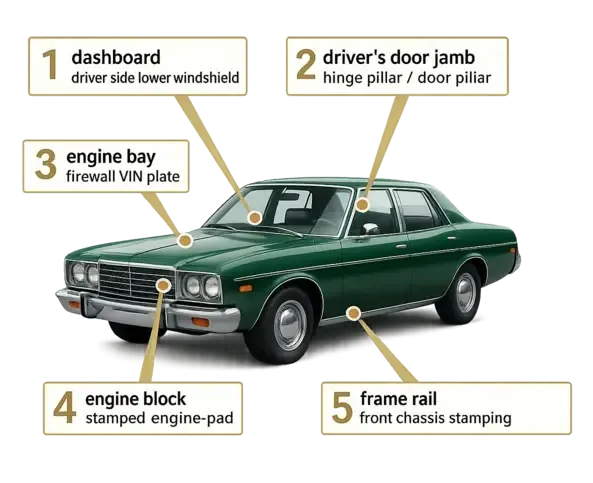
Classic VIN locations vary by make, model, and year. One car might have the number on the dash. Another may hide it on the firewall, frame, door jamb, or under old paint.
Bring a flashlight. Maybe a rag too.
Dashboard Near the Windshield
Many later classic cars have a VIN plate on the driver-side dashboard near the windshield. Stand outside the car and look through the glass.
If the plate is faded, dirty, or partly covered, take your time. A quick glance can lead to a wrong digit.
Driver-Side Door Jamb
Open the driver’s door and check the door jamb or door edge. Some cars have a manufacturer plate, certification label, or sticker in this area.
If the car was repainted, look around the label. Overspray, sanding marks, or damage may show that the plate area was disturbed.
Firewall or Cowl Area
Many older vehicles have the VIN, serial number, or body number stamped on the firewall or cowl. This area can be dirty, painted over, or crowded with wires and hoses.
Clean gently before reading the number. Do not scrape hard around an old tag or stamp.
Steering Column Area
Some classics place the VIN plate near or under the steering column. This spot can be awkward to see, especially in cars with dark interiors.
Use a flashlight and check from more than one angle.
Frame, Chassis, or Wheel Arch
Certain older vehicles use a frame-stamped or chassis-stamped number. Look around the frame rail, wheel arch, underbody, or chassis area based on the make and model.
If the underside is rusty, dirty, or low to the ground, be careful. Do not rely on one rushed look.
Title, Registration, and Old Records
The car itself is only one place to check. Look at the title, registration, insurance papers, service invoices, auction records, restoration receipts, and any old paperwork from past owners.
If the numbers do not match across those records, pause before moving forward.
How to Check a Classic Car VIN Step by Step
Once you find the VIN, slow down. Older numbers can be faint, scratched, painted over, or stamped unevenly.
Copy the VIN Exactly
Write the VIN exactly as it appears on the car. Watch for characters that look alike, such as 0 and O, 1 and I, or 5 and S.
One wrong character can point you to the wrong vehicle details.
Compare the VIN With the Title
The VIN on the vehicle should match the title. If it does not, ask the seller to explain the difference before agreeing to buy.
A mismatch can create problems with registration, insurance, resale, and ownership transfer. That is not something you want to discover after the car is already in your garage.
Check Other Vehicle Documents
Next, compare the VIN against the registration, bill of sale, maintenance records, restoration receipts, appraisal papers, and old auction listings.
The same number should appear consistently. If it does not, find out why. If the car has no title.
Inspect the VIN Plate for Tampering
Look around the VIN plate, not just at the number itself. Fresh rivets, scratched metal, uneven paint, rough edges, or strange plate placement can be warning signs.
Not every mark means fraud. Old cars have lived long lives. But if the tag looks disturbed, ask for more proof before trusting the deal.
Decode the VIN
After the VIN looks right, decode it. Depending on the vehicle, the VIN may show the make, year, model, assembly plant, body type, engine code, or production sequence.
For shorter VINs, these guides may help:
5-digit VIN decoder guide | 7-digit VIN decoder guide | 13-digit VIN check guideWhat If the Classic Car Has a Short VIN?
A short VIN is common on older cars. It does not automatically mean the car is missing numbers. Before 1981, automakers used their own systems, so VIN length and structure varied a lot.
Check the Vehicle Year First
The model year gives you the first clue. A 1950s car may use a simple serial number. A 1970s muscle car may include more coded information.
Do not judge an old VIN by modern rules too quickly.
Check the Make and Model
Manufacturers did not all follow the same pattern. Ford, Chevrolet, Pontiac, Dodge, Plymouth, Volkswagen, Porsche, Jaguar, Mercedes, and many others used different VIN structures depending on the year.
That is why make-specific decoding matters. The same number length can mean different things on different cars.
Check Supporting Tags and Stamps
If the VIN does not tell the full story, look for the trim tag, body tag, engine stamp, transmission stamp, chassis plate, or data plate.
These extra identifiers can help confirm whether the car matches its claimed build. They matter even more if the seller says the car is original, rare, or numbers-matching.
What VIN Red Flags Should You Watch For?
Classic cars can have paperwork quirks after decades of ownership changes. Still, some VIN problems should make you pause.
VIN Does Not Match the Title
This is one of the biggest warning signs. Do not buy the car until the mismatch is explained and properly documented.
A small typo may be fixable. A real mismatch can turn into a serious ownership problem.
Missing or Damaged VIN Plate
A missing or unreadable VIN plate can make registration and resale difficult. It may also raise questions with buyers, inspectors, or the DMV.
If the VIN cannot be verified, the deal becomes riskier.
Signs of a Replaced Tag
Fresh rivets, disturbed paint, uneven stamping, or strange placement may suggest the VIN tag was removed or replaced.
That does not always mean the car is stolen or fake. It does mean you need more documentation.
Seller Avoids VIN Questions
If the seller refuses to share the VIN, avoids paperwork questions, or pushes you to pay quickly, take a step back.
A good classic car deal should not feel like a race against the clock.
How Can You Organize Classic Car Records?
Once you check the VIN, keep all vehicle records in one place. This is useful if you own more than one classic, manage restorations, or plan to sell later.
Keep records such as:
- VIN details
- title documents
- registration papers
- service records
- photos
- build sheets
- restoration receipts
- appraisals
- insurance records
- sale or auction history
Good records tell the car’s story. More importantly, they make the story easier to prove.
Final Thoughts: Check the VIN Before You Trust the Story
A classic car can come with a great story, but the VIN helps you check the facts. Find the number, match it with the documents, inspect the plate, decode the VIN, and look for red flags before you buy, sell, or restore.
A few careful checks can save you from title trouble, wrong vehicle details, hidden history, or paying too much for a car that is not what it claims to be.
Before making a final decision, run a classic car history report to check available title, accident, theft, mileage, ownership, sales, lien, and auction records tied to the VIN.

Content Writer
Peter Adewale is an experienced automotive writer with more than eight years of content writing experience. At Classic Decoder, he creates informative articles on classic cars, vehicle history, VIN research, restoration, and collector-focused automotive topics. Known for his research-driven and reader-focused approach, Peter is passionate about producing content that helps enthusiasts and buyers better understand vintage vehicles, verify important details, and make confident ownership decisions.